Test fitting questions.

Scale Model Addict - Model Tips, Guides, Tools & Tech, Tutorials, and Community

Help Support Scale Model Addict:

scalebuilderchad

Well-Known Member
Joined
Aug 31, 2023
Messages
214
I have some test fitting questions.

When I build a model I paint all the parts and then assemble the kit. The only time I assemble before I paint is when pieces that are glued together are the same color and / or there is a seam I want to fill in. I don't really do any test fitting. And many times this leads me to last minute "oh sh*t" moments where I have to modify a part and repaint it before I can continue. And in the worst cases it causes me to even have to buy another kit and remedy that problem ahead of time.

So I ask you this.

I see people inline test fitting parts like in a way where I am sure they are glued together. What are you using to glue parts together that allows you to still take the kit apart afterwards?
 
link to what you are referencing please .

to this ---> " test fitting parts like in a way where I am sure they are glued together "
 
I have some test fitting questions.

When I build a model I paint all the parts and then assemble the kit. The only time I assemble before I paint is when pieces that are glued together are the same color and / or there is a seam I want to fill in. I don't really do any test fitting. And many times this leads me to last minute "oh sh*t" moments where I have to modify a part and repaint it before I can continue. And in the worst cases it causes me to even have to buy another kit and remedy that problem ahead of time.

So I ask you this.

I see people inline test fitting parts like in a way where I am sure they are glued together. What are you using to glue parts together that allows you to still take the kit apart afterwards?
I always try to test fit the parts as some kits don't always fit snugly. I usually clamp or tape something like a fuselage but just hold part's together to check the fit. If I'm happy then I use tamiya ultra thin adhesive to run along the joints without pulling them apart. Leave it a couple of hours and perfect joints.

Other's may do things differently and to be fair I have only been modeling a couple of years but it works for me.Pantherman
 
I usually test fit all my parts before gluing and painting.

When dealing with seams and or gaps, I'll sand it down lightly to a smooth finish - especially when glue seeps out. Sometimes, I'll use the blade of the hobby knife, then go over it with a sanding stick - preferably a light grit.
Even if you still see sort of a seam, sometimes I'll use Mr. surfacer and dab with a brush to fill it in. Sand lightly once dried sufficiently

As for gaps, there are different methods. My go-to is Perfect Plastic Putty by Deluxe. Easy to wipe down excess using water.
Another method is using small sections of sheet styrene then fill in with putty.

Another I have seen folks use is homemade Sprue glue. Do a search on YouTube on how to make your own sprue glue. I've never done it but it's something I thought about trying and experiment with it on a mule kit in the future.
 
link to what you are referencing please .

to this ---> " test fitting parts like in a way where I am sure they are glued together "
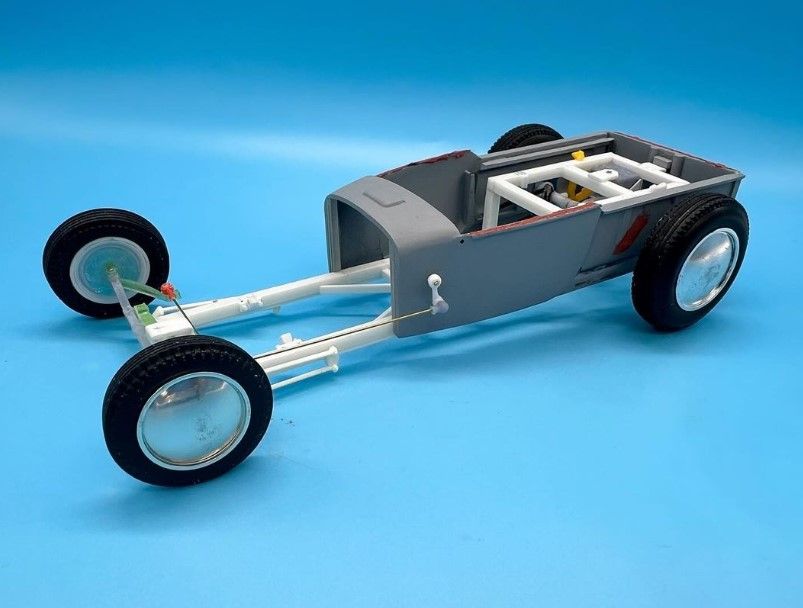
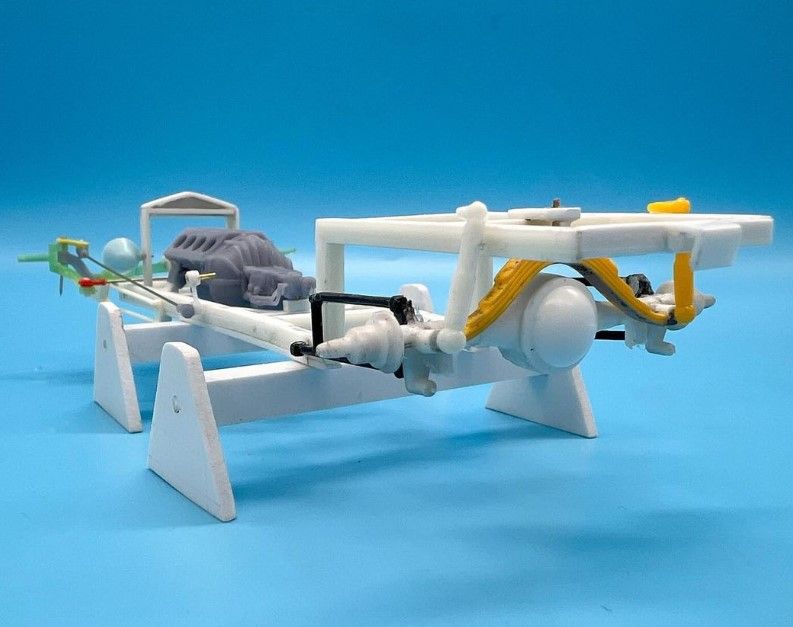
This guy always assembles his models unfinished, then disassembles and finishes the parts. I asked him on IG, but he never replied.

hotrod.jpg
 
As an Amazon Associate we earn from qualifying purchases. Product prices and availability are accurate as of the date/time indicated and are subject to change.
My biggest reason for test fitting is when there are pins in holes, tabs in slots, and of course things like hulls, wings, and a fuselage. Sometimes the smallest amount of sanding tabs of filing out a hole before paint makes a big difference.
I build cars and trucks. And with every build I always sand the hood so there are larger panels seems down either side. Then when all the paint is on there the hoods fit nice and neat.
 
I can easily see how that is sitting like that without any glue .
Where do you think that would need adhesive ?
 
Everything is pinned / indexed .
You didn't share a view of the rear .

If he used adhesive it's going to be a drop of PVA just to hold things in place . Just peels off when done with taking photos to confuse scalebuilderchad
 
Everything is pinned / indexed .
You didn't share a view of the rear .

If he used adhesive it's going to be a drop of PVA just to hold things in place . Just peels off when done with taking photos to confuse scalebuilderchad
But seriously. I'm sure it is pins and holes and built well. But how do you hold all those pins in holes without it all collapsing because it isn't fastened together.
 
Tight Fit .
No Glue .
No Magic .
Gravity always points Down . No floating away ...
 
To everyone that replied I should have been more specific.

I test fit one part to another part all the time. What I am referring to is I build cars and I like to customize them. One thing I always change is ride height. Fortunately I have been lucky and I usually get it right with some eyeballing.

I want to be able to put the front and rear suspension together and the wheels and tires on it. That hotrod might not have been the greatest example because that guy scratchbuilds and uses pins to hold everything together. A car kit doesn't stay together like that.

So I am essentially asking if there is a way I can glue a car kit together and still be able to disassemble it.
 
...I see people inline test fitting parts like in a way where I am sure they are glued together. What are you using to glue parts together that allows you to still take the kit apart afterwards?
Some modelers tack parts using white glue. It doesn't damage the styrene or resin, and it can be dissolved with warm water.
Some will just use tape to hold some parts together when test-fitting, or rubber bands, too.
Best thing to remember is: keep it simple.
 
I have not tried this but - seems to me rubber cement might work - it won't dry 'hard' - once you pull it apart the glue peels off really easily. I use rubber cement to position pieces in dioramas - don't usually pull them apart though.
This one , probably close to the norm , contains MEK and Toluene - both solvents for polystyrene .
 
Pfft . far from it
Fortunately the portion of organic chemistry concerning the compounds used in this hobby isn't that broad .
 
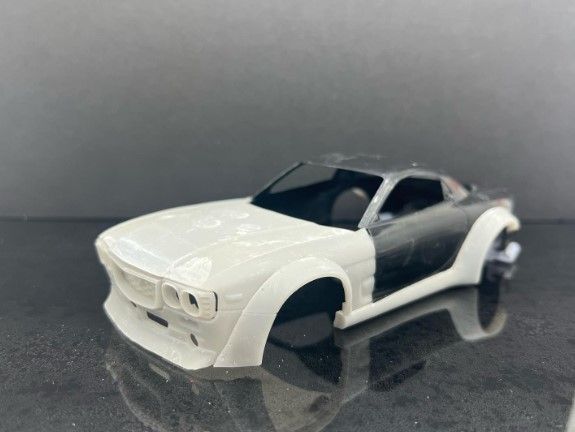
I would imagine its a combination of different things, some gundam builders use the blue tac for wall posters to hold things in place, i could imagine on the image with the door and body some is pressed on the back to hold the door in place. I think, at the end of the day unless you plan on taking pictures like that you can achieve the same just by using tape to test fit and hold things in place while building, or like urumomo said gravity and snug fitting pins lol
 
To everyone that replied I should have been more specific.

I test fit one part to another part all the time. What I am referring to is I build cars and I like to customize them. One thing I always change is ride height. Fortunately I have been lucky and I usually get it right with some eyeballing.

I want to be able to put the front and rear suspension together and the wheels and tires on it. That hotrod might not have been the greatest example because that guy scratchbuilds and uses pins to hold everything together. A car kit doesn't stay together like that.

So I am essentially asking if there is a way I can glue a car kit together and still be able to disassemble it.

My question is what is your reasoning to test fit the whole car kit? Usually test fit in our mind is test fit certain components, be it fuselage, wings of aircraft, body to chassis on auto kits, etc….

If it's the stance, you need to get 2 of the same kit. One would be your kit to work on stance. The second kit would be your kit to mirror the stance you were looking for. Does that make sense to you?
 
My question is what is your reasoning to test fit the whole car kit? Usually test fit in our mind is test fit certain components, be it fuselage, wings of aircraft, body to chassis on auto kits, etc….

If it's the stance, you need to get 2 of the same kit. One would be your kit to work on stance. The second kit would be your kit to mirror the stance you were looking for. Does that make sense to you?
I explained why I want to pre-assemble most of the vehicle. I need to sort out ride height, and fit larger and/or wider tires. I need to see what changes I have to make to the interior tub in order to get those tires to fit. I have to see what modifications I have to make to fit a larger motor. And things like that.

A second kit wouldn't solve this. A second kit would only give me spares if I screw something up.
 
white glue, tape, pins, rubber cement, you don't need to dryfit the whole model, just the sub assemblies to see if there are any obstructions to what you are trying to achieve.
 
white glue, tape, pins, rubber cement, you don't need to dryfit the whole model, just the sub assemblies to see if there are any obstructions to what you are trying to achieve.
But again. Ride height. I need to be able to have the front and rear suspension assemblies put together and mounted to the chassis. And then be able to flip the whole thing over and set it on my workbench. Put the interior tub in it to check for interference, and put the body on that to make sure it all fits.
 
Back
Top