Preparations for airbrushing

Scale Model Addict - Model Tips, Guides, Tools & Tech, Tutorials, and Community

Help Support Scale Model Addict:

DANIEL SANTOS

New Member
Joined
Jul 22, 2025
Messages
4
Hi,
I am going to airbrush for the first time a model kit. The paint I am going to use is Enamel paint that I am going to mix with some thinner.
I am thinking of using a small glass recipient to mix the paint with the thinner.
But was wondering how can I transfer the paint from the little cans to the glass recipient without making a mess and spilling paint ?
Same issue with then transferring the mixed paint to the airbrush gravity cup ?

Aside from that, before spraying the model, I think I should practice first on some surface. Do you recommend also plastic like
the model I am going to paint, or can it be wood ? As to the paint I think it better be the same as the one I am going to use to paint the model right ?

Thanks,
Regards
 
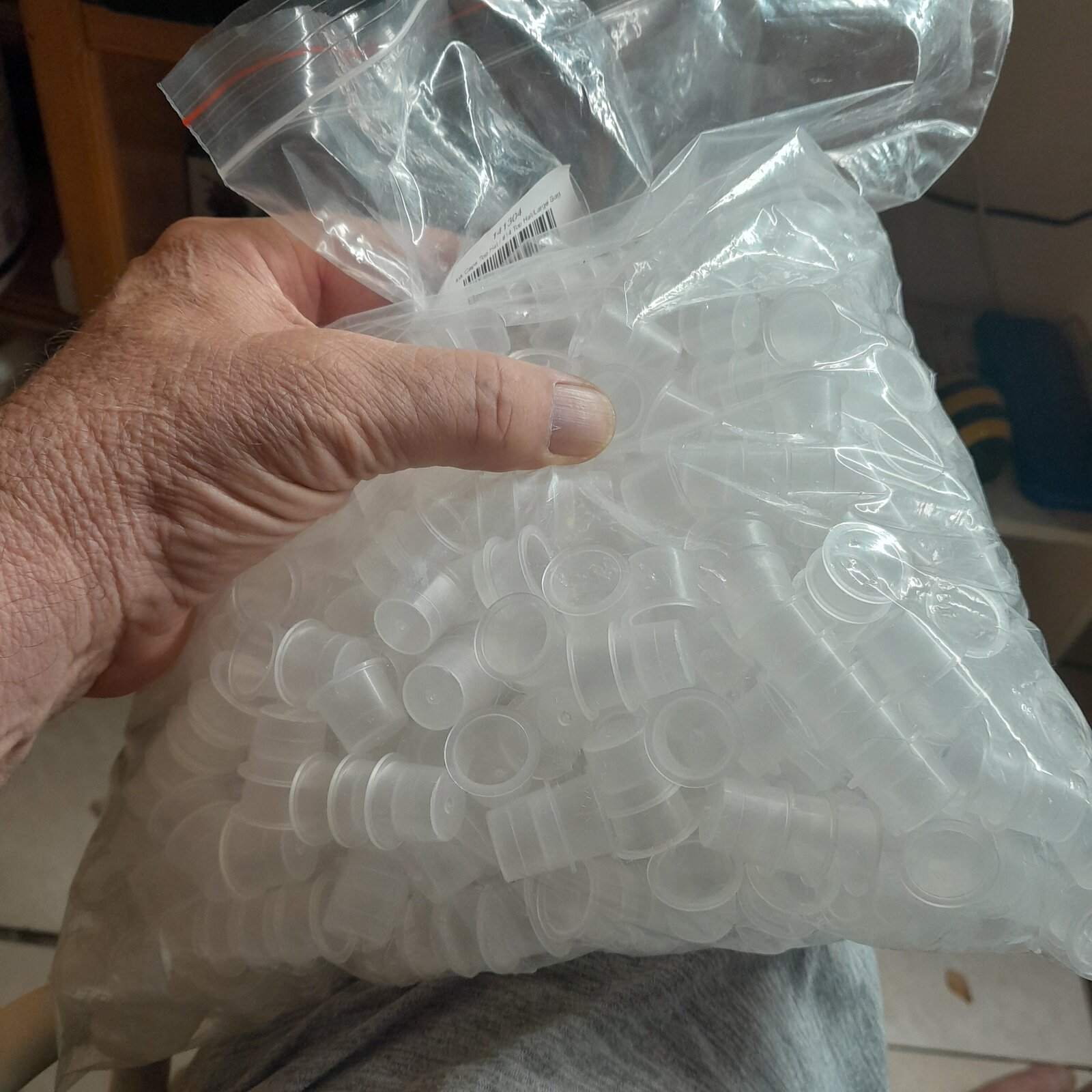
Yes, you lose a little bit of paint on the 1-in of the brush you let the paint run down on but it's better than getting paint on the lip of your bottle. Cuz that's sucks. And if you have access to a tattoo Supply shop? Go in there and they have about five different sizes of plastic disposable ink Wells. Just mix your paint and thinner up in it and throw it away.

20250724_143307.jpg
 
In the mean time, while this post wasn't approved and I didn't get any answers :)
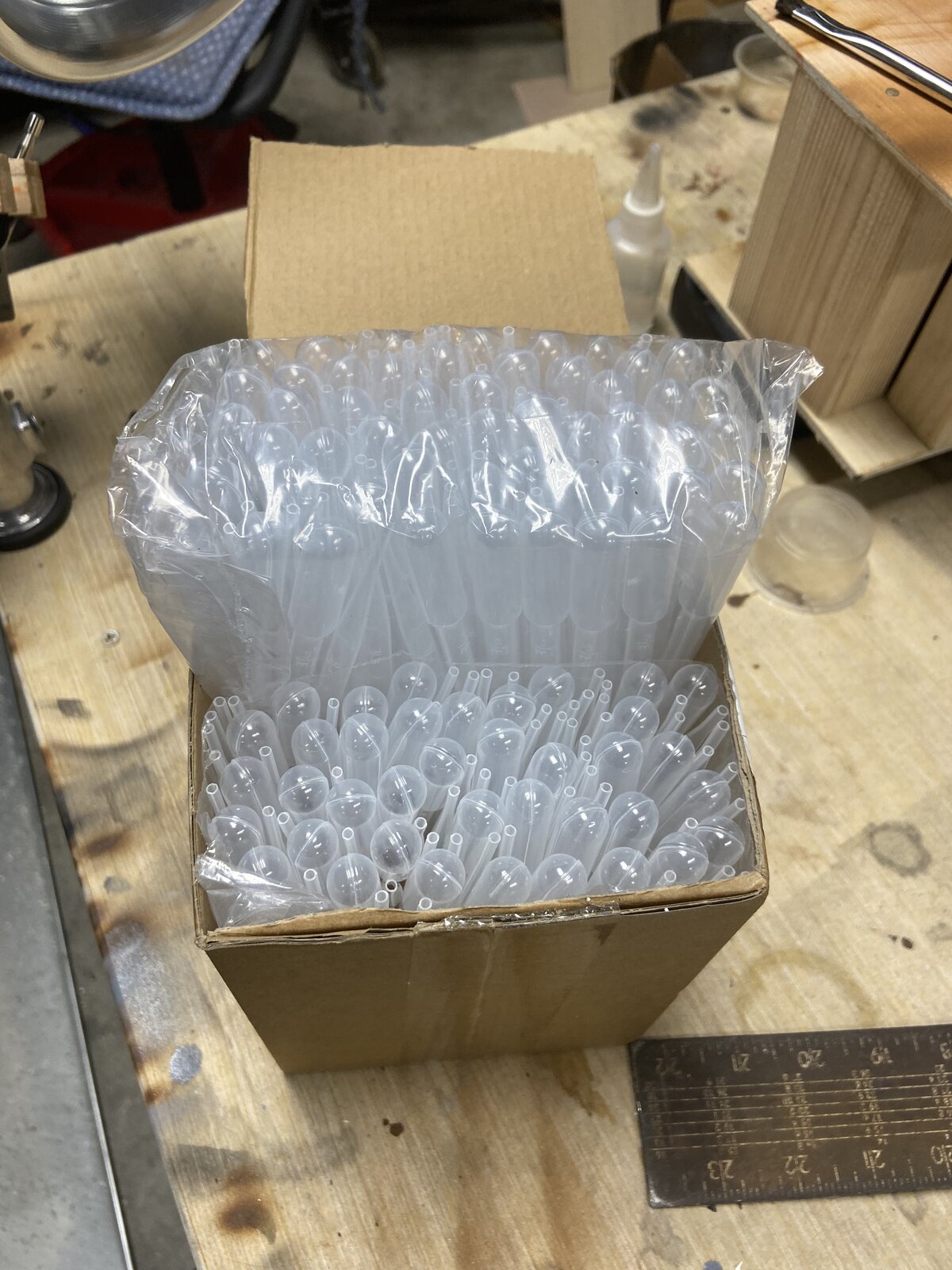
I got a set of small glass cups from a Chinese shop to do the mixing of the paint with the thinner, and a set of 6 glass pipettes with bottles to transfer the paint and thinner in controllable amounts to the little glass cups.
I went for all glass because I was afraid that the paint thinner would dissolve the plastic in the pipettes and cups.

As to the practice I ended up buying three 1:72 model airplanes to paint before I do the actual job that got me back into this hobby.
A few years ago I bought a 1:72 model submarine, an American Gato from Revell. The kit is quite big, it almost spans one meter in length. That one I don't want to make any mistake. I am a long time sub-simmer and saw this kit in a model shop a immediately decided I had to have it to display in the space where I sub-sim.

Anyway, what I have to spray in the submarine is the hull in two colours and the conning tower. The rest I am thinking of doing with a paintbrush. I don't have a notion of the amount of paint that will be necessary to paint the underside of the hull, it is the biggest area. I am going to use enamel, and the cans are so tiny, I don't know how many will be needed.

Also I saw in some you tube videos that when doing airbrushing, you usually apply a coat of primer, then paint with the airbrush, and finally apply lacquer. As to the primer I think it makes the paint adhere better to the plastic. But why does one apply lacquer in the end ?
 
As an Amazon Associate we earn from qualifying purchases. Product prices and availability are accurate as of the date/time indicated and are subject to change.
Depending on the brand/model airbrush you have, there may be an attachment to use with glass jars. Paasche makes such an attachment, for example, and some models come with glass jars, too. The jars are about the size of the larger Tamiya paint jars. That lets you mix paints in the jar and then spray directly from it.

As far as priming goes, it's not specific to airbrushing. Priming serves the main purpose of improving paint adhesion to the model's surface. Note that not everyone primes, though most modelers probably do. Priming also helps reveal any surface flaws that you might want to address before applying your color coats. Things like scratches, seams, sink marks, etc.

As for applying lacquer, do you mean a lacquer-based sealer coat, like Testor's DullCote? That step serves a couple of purposes. One, it seals all the work you've done up to that point, such as color coats, decals, weathering, etc. Two, it makes the finish matte or gloss, as appropriate to the subject. There is a good selection of such products. I like DullCote myself, because I use the rattlecan product, which I find easiest. But many can be applied with an airbrush. DullCote comes in a version that is meant for airbrush application, too.

Hope that helps!

Best regards,
Brad
 
I went for all glass because I was afraid that the paint thinner would dissolve the plastic in the pipettes and cups.
Nope , they are polyethylene and completely resistant to solvents , including butyl acetate , ethyl acetate , acetone etc .
Enamels use mineral spirits / paint thinner anyways and that will not attack any any plastics , much less polyethylene .

There is no such thing as " lacquer base " , unless it is a true lacquer paint .
Most all hobby paints labeled lacquer by vendors are acrylics . There are very few actual lacquers in the scale model hobby market .
Lacquer is technically nitrocellulose , which would be the resin binder like acrylic is the binder in acrylic paints or alkyd is the binder in enamels .
" solvent base acrylics " use acrylic resins that are compatible with alcohols and ketones ( like acetone ) and are unfortunately referred to as lacquers . ( they ain't , but we're stuck with this terminology now )
 
Also I saw in some you tube videos that when doing airbrushing, you usually apply a coat of primer, then paint with the airbrush, and finally apply lacquer. As to the primer I think it makes the paint adhere better to the plastic. But why does one apply lacquer in the end ?
in the end , applying a clear coat , often called varnish , is done to either unify the sheen ( flat , gloss , satin ) and / or protect the color coat from weathering products and sometimes make decal application easier --- but it's just the resin binder without any pigment .
It can be an acrylic , enamel or and actual lacquer varnish .
 
Pipettes work well and have a lined paint measurement reference. What type of airbrush, single or double action?
IMG_3030.jpeg

Pep
 
I have two airbrushes :
  • the first I bought a few years ago never used it, is a pro-insa. Don't know the model. The paint is stored in a glass bottle underneath the airbrush.
  • then I bought another one, a Tamyia, which is double action. It has a trigger like a pistol instead go the little button on top.

I can take pictures of them when I get a chance
 
in the end , applying a clear coat , often called varnish , is done to either unify the sheen ( flat , gloss , satin ) and / or protect the color coat from weathering products and sometimes make decal application easier --- but it's just the resin binder without any pigment .
It can be an acrylic , enamel or and actual lacquer varnish .
So do you not spray a final clear over the decals? I always thought that was how it was done.
 
I have two airbrushes :
  • the first I bought a few years ago never used it, is a pro-insa. Don't know the model. The paint is stored in a glass bottle underneath the airbrush.
  • then I bought another one, a Tamyia, which is double action. It has a trigger like a pistol instead go the little button on top.

I can take pictures of them when I get a chance
No need, I can envision what they are.... The double-action uses more air than a single-action; canned air will bankrupt a user. A compressor is the fix.

Just FYI
Pep
 
Hi,
I am going to airbrush for the first time a model kit. The paint I am going to use is Enamel paint that I am going to mix with some thinner.
I am thinking of using a small glass recipient to mix the paint with the thinner.
But was wondering how can I transfer the paint from the little cans to the glass recipient without making a mess and spilling paint ?
Same issue with then transferring the mixed paint to the airbrush gravity cup ?

Aside from that, before spraying the model, I think I should practice first on some surface. Do you recommend also plastic like
the model I am going to paint, or can it be wood ? As to the paint I think it better be the same as the one I am going to use to paint the model right ?

Thanks,
Regards
Hi and welcome to the forum. Pipettes are the way to go. Pantherman
 
You know what I think? I don't think Daniel San is picking up what we're laying down. He even said no one answered him.
No idea .
Did you figure out what was up with the alcohol separating from that Tamiya paint you mixed ?
I wouldn't expect such an extreme stratification like you described since the resin was already in solution out of the bottle .
I don't use Tamiya paints - with the exception of the rattlecan primers .
 
You can reuse them forever , depending .
The only caveat is avoiding a layer of dried paint building up and contaminating future paint used .
Nothing really sticks to PE ( polyethylene ) so it's not really an issue --- they are so cheap too , so just trash it if unsure .
You can flush them with solvent , mineral spirit for enamels , after use to extend usage .
Not even dichloromethane , used for solvent welding ABS , will damage them .

Sometimes they will eventually split along the seam , but that will be obvious .
 

Latest posts

Back
Top