Returning to Modeling After 50+ Years - Need Advice...

Scale Model Addict - Model Tips, Guides, Tools & Tech, Tutorials, and Community

Help Support Scale Model Addict:

Albireo

Well-Known Member
Joined
Jun 17, 2025
Messages
67
Hello all. I'm 66, retired and looking to get back into building models. Last did this sort of thing when I was 14 or so. Back then it was all cars, now it's going to be space and sci-fi stuff.

My question has to do with painting. Back then it was either tiny bottles and small paintbrushes or small spray cans. Results were mixed. Now of course I am aware of Airbrushes and from what I understand they are much better both in terms of the quality of the paint job that can be achieved as well as being more economical from a paint standpoint. I've got zero experience with them and so I don't want to sink too much money into one (yet) until I know I'm up to the task. So, what would you recommend as a good starter model (meaning airbrush model)?

Also, I'm trying to set up a section in my basement to have as my model shop. Does airbrush painting require the same amount of ventilation as it was when using the old spray cans?

Thanks in advance.
 
If it's within your start up budget, I'd recommend an Iwata Eclipse. You can spray anything from acrylic to lacquers with great results. If you are using solvent based paints, you will want to vent to the outside. Not as bad as rattle can, but more nasty fumes than I'd want in my house/lungs.
 
If it's within your start up budget, I'd recommend an Iwata Eclipse. You can spray anything from acrylic to lacquers with great results. If you are using solvent based paints, you will want to vent to the outside. Not as bad as rattle can, but more nasty fumes than I'd want in my house/lungs.
Hi, so water based is the opposite of solvent based paints correct? And they would need much less ventilation then?
 
^^^^^

A water based acrylic like Vallejo is going to be safer than a lacquer. I'd probably at least wear a dust mask if I didn't have a booth. Everybody has a different tolerance for risk.
 
There is a learning curve. I bought my first decent airbrush 4 years ago, at 65, even though I've been modeling since the 60s. After four years, and hours of YouTube videos, I consider myself adequat. That said, it is very worth it. My models are much better because I spent the time to learn how to use it.
 
As an Amazon Associate we earn from qualifying purchases. Product prices and availability are accurate as of the date/time indicated and are subject to change.
Welcome to SMA!! As another newcomer, be assured that this Forum is very supportive and knowledgeable. It's been a great experience.
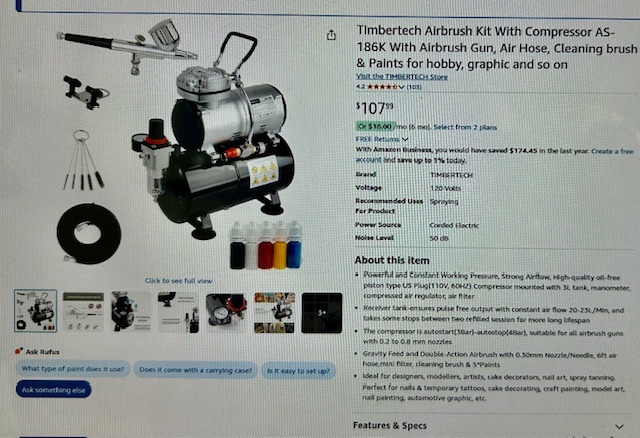
Airbrushing changed my appreciation for modeling again. I suggest Acrylics due to ease of cleaning and toxicity, ventilation, etc. I also picked up a very quiet air compressor that was inexpensive, a TimberTech AS186. Please consider airbrushing to enhance your retirement!
 
^^^^^

A water based acrylic like Vallejo is going to be safer than a lacquer. I'd probably at least wear a dust mask if I didn't have a booth. Everybody has a different tolerance for risk.
OK, well, I may have to do this work in my garage with the doors open. Hmm...
 
There is a learning curve. I bought my first decent airbrush 4 years ago, at 65, even though I've been modeling since the 60s. After four years, and hours of YouTube videos, I consider myself adequat. That said, it is very worth it. My models are much better because I spent the time to learn how to use it.
Hi Bob. That's what I'm thinking. I want the models I work on to look as good as I can make them so I'm willing to put in the time to learn. Can you share any of the videos that you watched that you found helpful?
 
Welcome to SMA!! As another newcomer, be assured that this Forum is very supportive and knowledgeable. It's been a great experience.
Airbrushing changed my appreciation for modeling again. I suggest Acrylics due to ease of cleaning and toxicity, ventilation, etc. I also picked up a very quiet air compressor that was inexpensive, a TimberTech AS186. Please consider airbrushing to enhance your retirement!
Thank you! So Acrylics = water based correct? Thanks for the recommendation.
 
I have a similar story to yours. I built quite a bit when I was a kid and I have started the hobby again in my early sixties. I'll try to give you a few answers to your questions based solely on my experience starting back up.

After a LOT of research and YouTube videos, I purchased an Iwata HP-CS as my first airbrush. I really do not think I could have chosen better (I now own five different airbrushes so I have some basis for comparison). I got the cheapest Amazon compressor with a tank I could find (I think it was around $70). It has worked flawlessly. I still suck at airbrushing but my results are head and shoulders above what brush painting could have provided.

Video choices to learn?!? It's a virtual rabbit hole. I have found several that I keep coming back to because I enjoy the personality and delivery of the poster. I now often look for videos that cover the exact model I am building or considering building. I think it is a personal choice to be honest, as to who you would want to follow. I will say one thing about YouTube though. I sometimes find myself thinking I can easily re-produce what I am seeing on a video, at my own desk. Soooooo not true. I think it's known as "delusions of grandeur" or something like that. Those folks make some very difficult tasks seem so darn easy. If I have learned nothing else from all of the videos I have watched, I now know it takes a lot of practice to produce worthy results.

One last thing before this gets too long. I have to tell you that the learning curve regarding this hobby is steep. I still struggle with just how different acrylics, acrylic-lacquers, enamels, water, isopropyl alcohol, mineral spriits, lacquer thinners, varnishes, oils, retarders blah-blah-blah function under and on top of one another. Which thinner works best with which paint....what can you layer on top of what paint and not do significant damage and what can you substitute for something more expensive and still get good results. Oh! Scalemates.com is your friend! Use that website! I do a ton of my model purchasing research on that site.

Good luck and just know that if you are patient this hobby can be very rewarding and relaxing (most of the time).

David
 
^^^^

I think Barbatos Rex on You Tube taught me more about paints and airbrushing than anyone else. That guy tests and sprays a LOT of paint.

If you decide to focus on acrylics, I'd suggest trying something other than Mission Models. Their three part mixing process is tedious and silly when there are ready to spray options like Vallejo available.
 
Not true. There are water-based acrylics and alcohol-based acrylics make sure to check manufacturers website or at least google them. I use Tamiya acrylic and they are alcohol-based. Also make sure to check recommended thinner.
OK, I'm confused. So, in terms of ventilation, smell, toxicity, ease of use, cleaning, etc. what is best? Would it be a water based acrylic or ??
 
I use Tamiya acrylics and Tamiya Thinner 50/50 mix. Not toxic per se. I clean the airbrush with acetone which doesn't have "much" vapor and with minor ventilation works well. I have a window near my work bench that I have a fan set on low drawing air outside. I wear a dust mask most of the time, not always. There's a LOT of excellent info given above. Do some research, ask more questions and then make your best choice. It's worth the jump.
 
Airbrushes are kind of like telescopes

A lot of people entering the hobby go for the "starter" one

The problem is the cheap "department store starters" often cause more problems and disappointment in performance driving them right back out of the hobby

i.e. getting one of those cheap starter airbrush sets that run off canned air is kind of a waste as you will either quickly outgrow it, or be driven out in frustration

However, that does not mean you have to go for a high end item out of the gate

I'd look for a decent middle of the road set

Features to consider...

For a starter, you will want a gravity feed rather than one with bottles that attach to it

The larger the gravity feed paint cup, the better (otherwise if a small one, you will be constantly pouring in paint rather than spending more time painting)

You also will want a "dual action" vs "single action" as you will have more control over paint and airflow. The cheap starters tend to be single action

You also want a decent air pump. The canned air route will get expensive quick if you are going to ever be doing more than one or 2 projects, or larger scale stuff
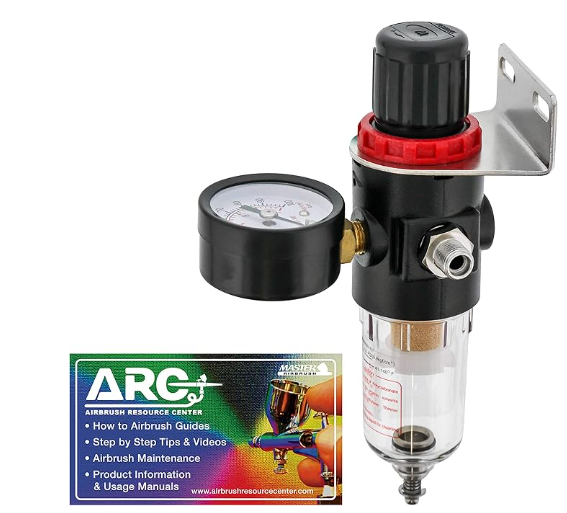
Ideally you will want a compressor that has a psi regulator. If not, you should at least invest in one that you can attach like this
1750262858887.png
 
OK, I'm confused. So, in terms of ventilation, smell, toxicity, ease of use, cleaning, etc. what is best? Would it be a water based acrylic or ??
You do not want to inhale any paint or its solvents, that includes "water based" acrylics. A spray booth is a very good idea regardless of the paint or other chemicals you may use. Toxicity is a difficult subject, even if you have the technical background to understand the chemistry and the biology. And here's the killer: Any material not proven to be toxic beyond the tiniest amount of doubt can be sold as "non-toxic." Toxicity research was twenty years behind when I left material science over 25 years ago. That situation has gotten worse since then.

For example, "water based" acrylic paints are generally much less toxic than "solvent based" paints. That does not mean they are "safe" to inhale, get on your skin, or in your eyes.

Pets like dogs, cats, and birds are far more susceptible to toxic substances, and some things that cause us little harm can be deadly to them, and in much smaller quantities.

"Safe" does not exist in the real world. Only "more safe" and "less safe" have any real meaning.

"Adequate ventilation" is defined as a well-functioning spray booth, or outside. Outside is often not practical in terms of scale models.

Instructions and considerations for spray booths can be found online. If you are exclusively using non-flammable materials for building and painting, one can even be made of wood.

So to answer your question, what is best is to invest in a good spray booth, bought or home-built. I use acrylic paints exclusively, mostly Vallejo, some Tamiya. For Vallejo, their proprietary thinner and cleaner work very well. For Tamiya X and XF series paints, 90% isopropyl alcohol serves both functions.

I'm also a fan of GREX airbrushes: excellent performance and easier to clean than any other I've seen or tried. Thayer & Chandler are also good, and of course there are cadillacs like Iwata. Be advised that learning to airbrush is 75% science and 50% art. Just do the math. :rolleyes: Buy a decent air brush, not a cheap one from Amazonk.That will save a lot of frustration.
 
Yeah that set looks like a pretty good deal

nice size paint cup, dual action, pressure regulator/moisture trap and even a set of pipe cleaners thrown in

as a later expansion if you start getting the desire to go to the next level would be some different nozzle sizes for finer detail line work, but that is not really needed
 
I'd also scroll through some reviews.

Have to be careful though. Some negative reviews are just frustrated people who have had issues understanding how to get an airbrush to work and all the factors involved like paint thinning etc... but blame it on the equipment
Likewise a lot of the 5 star reviews are just garbage as far as useful comments beyond "works great" or are "bought"

I find the middle of the road 5 star reviews, like those with a 2, 3 and 4 are more telling, especially if the comments are more than "this sucks"

Most importantly, look for patterns in those 2, 3 and 4 star review comments. If there are a lot that mention the same problems or issues from multiple reviewers those are the ones to pay attention to, or on the flipside, they mention the same perk etc...

For example, if most comments in reviews mention "the compresser is pretty loud" that might be something to consider if you live in an apartment and will be painting late at night
 
Late to the party as always, but I use a GS23 Masters airbrush from amazon, bought it for $18 usd. I have used it for almost 5 years now, and I am getting a rebuild kit to get it working again (I abused it and it quit working.) I already had an air compressor.
 
You do not want to inhale any paint or its solvents, that includes "water based" acrylics. A spray booth is a very good idea regardless of the paint or other chemicals you may use. Toxicity is a difficult subject, even if you have the technical background to understand the chemistry and the biology. And here's the killer: Any material not proven to be toxic beyond the tiniest amount of doubt can be sold as "non-toxic." Toxicity research was twenty years behind when I left material science over 25 years ago. That situation has gotten worse since then.

For example, "water based" acrylic paints are generally much less toxic than "solvent based" paints. That does not mean they are "safe" to inhale, get on your skin, or in your eyes.

Pets like dogs, cats, and birds are far more susceptible to toxic substances, and some things that cause us little harm can be deadly to them, and in much smaller quantities.

"Safe" does not exist in the real world. Only "more safe" and "less safe" have any real meaning.

"Adequate ventilation" is defined as a well-functioning spray booth, or outside. Outside is often not practical in terms of scale models.

Instructions and considerations for spray booths can be found online. If you are exclusively using non-flammable materials for building and painting, one can even be made of wood.

So to answer your question, what is best is to invest in a good spray booth, bought or home-built. I use acrylic paints exclusively, mostly Vallejo, some Tamiya. For Vallejo, their proprietary thinner and cleaner work very well. For Tamiya X and XF series paints, 90% isopropyl alcohol serves both functions.

I'm also a fan of GREX airbrushes: excellent performance and easier to clean than any other I've seen or tried. Thayer & Chandler are also good, and of course there are cadillacs like Iwata. Be advised that learning to airbrush is 75% science and 50% art. Just do the math. :rolleyes: Buy a decent air brush, not a cheap one from Amazonk.That will save a lot of frustration.
That reminds me: I found this for a DIY spray booth and filter online:

https://www.starshipmodeler.com/tech/pa_booth.htm

Don't know if it would help anyone here out, but since the materials are simple (and relatively cheap!), I figured it couldn't hurt to suggest it!
 
Hello all. I'm 66, retired and looking to get back into building models. Last did this sort of thing when I was 14 or so. Back then it was all cars, now it's going to be space and sci-fi stuff.

My question has to do with painting. Back then it was either tiny bottles and small paintbrushes or small spray cans. Results were mixed. Now of course I am aware of Airbrushes and from what I understand they are much better both in terms of the quality of the paint job that can be achieved as well as being more economical from a paint standpoint. I've got zero experience with them and so I don't want to sink too much money into one (yet) until I know I'm up to the task. So, what would you recommend as a good starter model (meaning airbrush model)?

Also, I'm trying to set up a section in my basement to have as my model shop. Does airbrush painting require the same amount of ventilation as it was when using the old spray cans?

Thanks in advance.
I went thru similar start up in Nov last year and having more disposable income now than forty five years ago I bought a bunch of stuff. Some I realize now I may never use. I also went with Vallejo paints and realized did not like them and tossed a bunch. Now I am all in with Tamiya paints for air brushing. I am no expert air brusher but getting better. I first got a Paache Talon TG-3. I think $120. I would say this is mid range. Dual action. It has multiple needle sizes. I was not happy with it. Harder to find parts and clogged with tip-dry easily. But that may have been the Vallejo paints though because that is big issue with them. The trigger also kept sticking. Tossed it. Next tried cheapo mastercraft ones, like $50 each. One was side feed, crap, one trigger type, crap. Finally bought both an Iwata Eclipse CR (.5mm) and CR3 (.3mm). Both were $120 I believe. Have been very happy with them.
 
Late to the party as always, but I use a GS23 Masters airbrush from amazon, bought it for $18 usd. I have used it for almost 5 years now, and I am getting a rebuild kit to get it working again (I abused it and it quit working.) I already had an air compressor.
A new user will only get frustrated by a cheapo air brush in my personal experience. Go mid range from start. Don't think a model maker ever needs a $700 high end air brush, but users of them may swear by them, just like some people who use cheap Amazon brands. Although cheap for how long, almost all are made in China.
 
That reminds me: I found this for a DIY spray booth and filter online:

https://www.starshipmodeler.com/tech/pa_booth.htm

Don't know if it would help anyone here out, but since the materials are simple (and relatively cheap!), I figured it couldn't hurt to suggest it!
The only problem I see with that is the motor. If you are using any flammable solvent, it needs to be an "explosion proof" motor. It also has to have the capability of exhausting air at a sufficient rate, usually expressed in cubic feet per minute.
 
That reminds me: I found this for a DIY spray booth and filter online:

https://www.starshipmodeler.com/tech/pa_booth.htm

Don't know if it would help anyone here out, but since the materials are simple (and relatively cheap!), I figured it couldn't hurt to suggest it!
The only possible problem I see with this is that it must be an "explosion proof" motor if any flammable solvent is to be used. The blower must also have a sufficient cubic feet per minute rating.
 
The only problem I see with that is the motor. If you are using any flammable solvent, it needs to be an "explosion proof" motor. It also has to have the capability of exhausting air at a sufficient rate, usually expressed in cubic feet per minute.
Yeah; since I plan on doing this one in the near future, that's exactly what I plan looking into. I don't want to build a BBQ grill by mistake!
 
No idea what your budget allows, but I've been very happy with my Pace Peacekeeper booth. You have an out of the box set up with a solvent safe fan, lighting, filter holder for 1" furnace filters, aux power outlets and a 4" exhaust fitting for exterior venting. The one I have came with a 265CFM blower, so theoretically changes its air about every 2 seconds. I'm sure inefficiencies in duct resistance, etc reduce that, but even if it is changing half that often, it's pretty dang good.

https://www.pacepaintbooth.com/36-inch-deluxe/
 

Latest posts

Back
Top