I used the AK gen3 thinner. It may well have to do with drying time... the underbelly was painted a good week before the masking putty... and there was no noticeable discoloration along the upper/lower dividing line of the fuselage.thin them

I used the AK gen3 thinner. It may well have to do with drying time... the underbelly was painted a good week before the masking putty... and there was no noticeable discoloration along the upper/lower dividing line of the fuselage.thin them
...interesting. something to try out, which means the putty needn't touch the painted surface.and then add a small rope of blue tack to feather
There may be a tiny bit of contact right along the edge of the tape, but it gets hidden in the blending of the camo colors....interesting. something to try out, which means the putty needn't touch the painted surface.

What solvent system do AK paints use? Do they recommend only using their thinner? I don't recognize the abbreviation "MR"—who dat?Of course, the last consideration, and now my brain hurts, is the primer. It was a MR Aqueous grey.
Thanks to all for your input and advice.

3rd gen is acrylic and water based. Real colors is lacquer based. I use any water based thinner for AK 3rd gen but use AKs real colors thinner for their lacquer based paints.What solvent system do AK paints use? Do they recommend only using their thinner? I don't recognize the abbreviation "MR"—who dat?
Yup, and I used their gen3 thinner for it.3rd gen is acrylic
Well, I have to speculate, then. Acrylic paints cure slowly, and those with aqueous solvent systems cure more slowly than alcohol systems because the water evaporates more slowly than alcohol. If the mask is applied before evaporation (and thus curing) is complete, that could lead to the problem you experienced. It is also possible that the flat paint surface, even if fully cured, absorbed something from the masking putty. Had you used the putty mask to cover the entire area being masked off, the darkening would affect the whole area and might not be noticeable.Yup, and I used their gen3 thinner for it.
I've used Silly Putty quite often for camouflage masking and sometimes it would leave the different color like you have in your photos. I don't know why it happens, but it was always evened out when I put on a clear coat prior to decals. I've never used the AK brand putty.From what I've seen of other folks' results, it must be something I'm doing; their success is what prompted me to try it out!
Having worked with the putty, it has the advantage of being able to shape it in raised cords, that allows use of the airbrush to achieve a 'soft' edge if desired.
Both the liquid film and masking film will produce a crisp edge, which also is perfect for given situations.


One thing with what you saw, I had the EXACT SAME result with different paints.as much as we can ascertain
That makes sense—there may be a volatile component in the compound, left over from the manufacturing process, that causes this. The solution would then be to take the new material out of its container, spread it out on an impervious surface, wait an hour, flip it over, wait another hour, then use it on a paint hulk and see if the problem recurs. The 1 hour wait time is entirely arbitrary.One thing with what you saw, I had the EXACT SAME result with different paints.
The one thing we had in common was brand new masking material.
While the masking "worms" were a different product, they were both fresh from their packaging, I suspect there was some sort of preservative on them that did this. I used the same sticky-tack several times later with no ill effect.
...nothing to lose at this point!spread it out
"Junk" is something you save for twelve years, then throw out one day before you desperately need it.before even considering the garbage bin.

Oh, I get this.Unfortunately, I inherited too many of my grandparents' 'make do' genes, who never threw anything out, saving string on spools fabricated with can tops and old thread spools, some of which later would later be braided into rope... or plastic bags braided into mats, to name a few... country folk born in the 1890s could not help but look at any new material, including plastic, and think: "what could I use this for?" before even considering the garbage bin.
... especially since the folks left with your 'invaluable stuff' won't have a clue what to do with most of it.It ain't easy though

 to try and touch it up, as well as soften the upper/lower fuselage line.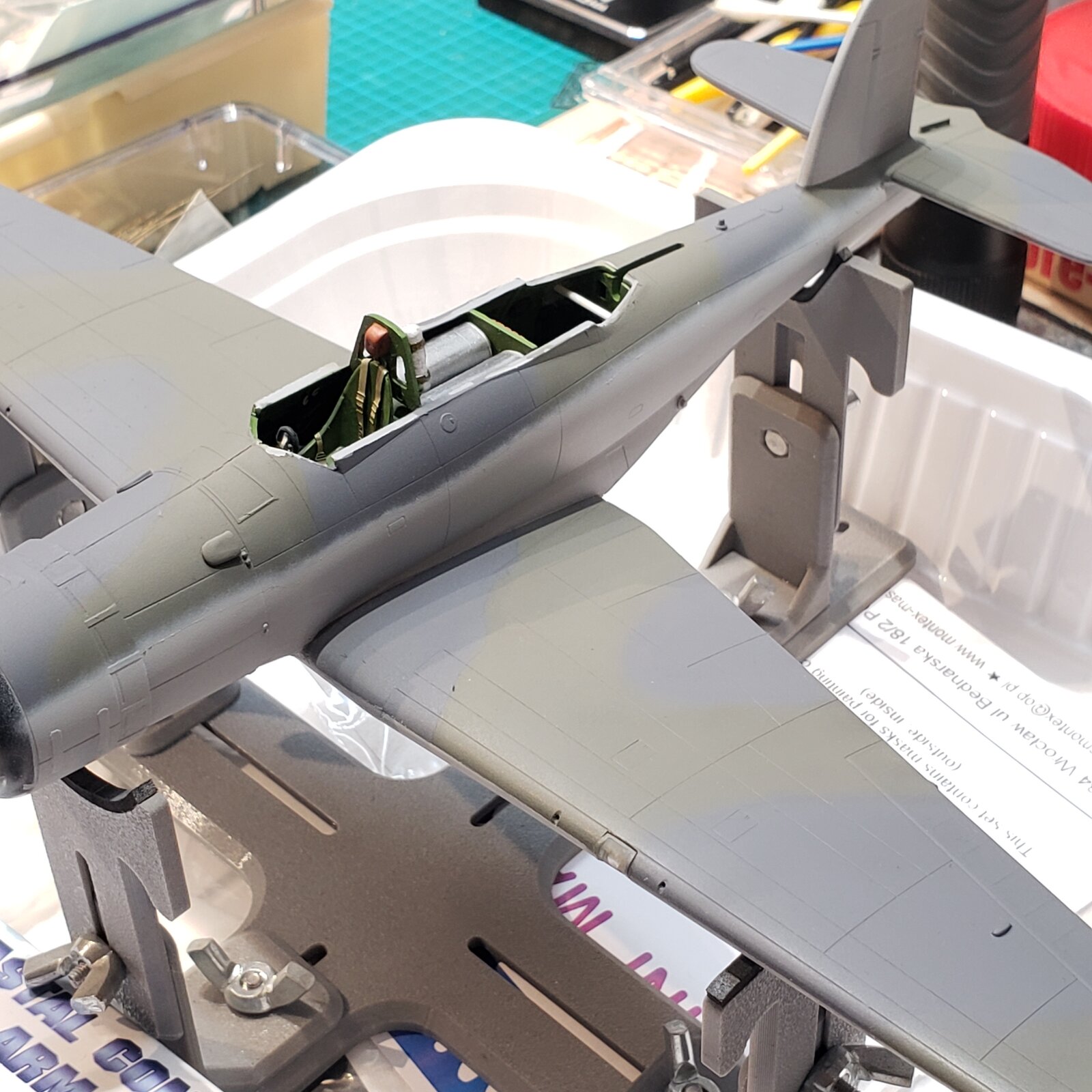
The application and demarcation look great, and it could be the lighting but...is there enough contrast?and went back in FREEHAND
Funny you should mention that. The light at my bench is pretty bright, and the relative contrast of the two colours is low, straight out of the bottle. I feel like there was more before I went back in to correct the discoloration; freehand spraying, though low pressure and narrow fan, took any crispness in the border between the colours out.The application and demarcation look great, and it could be the lighting but...is there enough contrast?
Thanks, it will be a while before I actually get results on purpose, so luck, and experience from building other genres helped a lot!Ok, maybe it is just me. I kind of like the color tonal variation. I think I will try it and even add some more shading and lighting inside the camouflage pattern.
BTW good looking plane!


![Pampers Sensitive Baby Wipes, Clinically Proven, Fragrance Free, Unscented, Water Based, Hypoallergenic, Multi-Use, Hand Wipes 336 Wipes Total (6X Flip-Top Packs) [Packaging May Vary]](https://m.media-amazon.com/images/I/41KLBHu9CAL._SL500_.jpg)