Jakko
Well-Known Member
No, it isn't:No. The official definition of 1 yd is 3 ft. The official definition of one foot is 12 in.
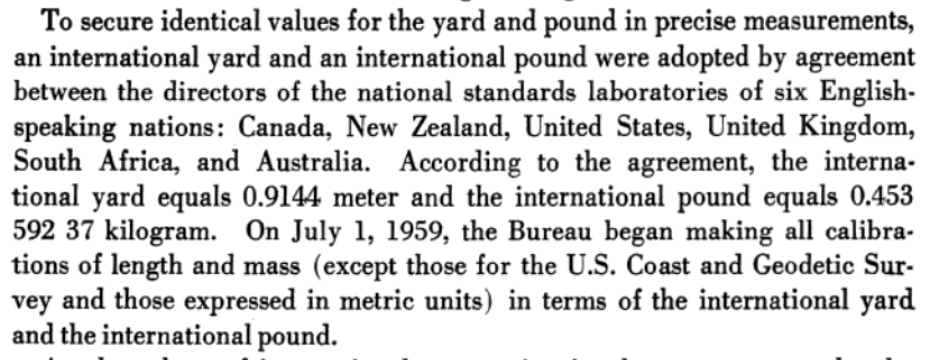
Which pound, which yard and which gallon? Because everybody had different values for units with nominally the same names. Not just different countries, but different regions, towns and cities within countries had differing values.But I wonder why, when the busybodies decided to invent a new measuring system out of whole cloth that they did not just say 1 kilogram was 1 pound, or one meter was one yard or one gallon (or quart) was 1 liter.
The original definition of a metre was ¹⁄₁₀ ₀₀₀ ₀₀₀ of the distance between the equator and the North Pole, measured along the meridian that goes through Paris. This is an arbitrary choice, but all units of measurement are arbitrary choices — there is no way to base any on a natural, intrinsic, totally objective property. So they picked the size of the Earth to establish the length of the metre. Everything else in the original metric system derives from that: an are (/ɛəɹ/, not /ɑɹ/) is an area of ten by ten metres; a litre is a volume equal to one-tenth of a metre, cubed; a gramme is the weight of a volume of water equal to ¹⁄₁₀₀ metres, cubed.I am forced to conclude they made **** up out of nothing whatsoever, just to be obstinate and arrogant.
Basically, they said to themselves: we need a system in which there's a basic unit that can be derived from measuring something of fixed size, and then everything else will be taken from that. Which means there's really only one arbitrary unit instead of having pretty much everything as arbitrary and impossible to figure out except by looking up how big it is.
This has been refined in various ways since then, to arrive at the present definitions of the seven SI base units, all of which can be determined from basic properties of nature by anyone with the necessary equipment (which, admittedly, is not within reach of you or I).
This is not an argument in favour of, or against, any system of measurements. Rather, it's your personal experience and knowledge that make one of the two difficult to use for you.I admit to the logic of a system based on 10s instead of 12s, it clearly has advantages. But having spent a lifetime using miles and ounces I cannot guess how many kilometers away that next hill is when I can guess fairly accurately how many miles it is, or pick out a spot in that field that is really close to 100 yards away.
For an example from the other direction: a few years ago, I tried laying out a book in inches in Adobe InDesign, and I don't think I want to try that again. Unlike most people outside the English-speaking world, I am pretty well-versed in Anglo-American units of measurement, but actually using them in practice is a major pain in the backside if you're used to metric.
But the way that most people go wrong in this (and that I tried to avoid, but semi-failed at) is converting to the system they are used to. So they measure 134 cm as the width available for the shelves they want to put up, convert that to 52³⁄₄ inches and then saw planks to that length instead of marking out 134 cm on the plank directly.
They didn't, and one of the possible systems was adopted in France in the 18th century. This is why Napoleon is usually said to have seized power on 18 Brumaire VIII rather than on 9 November 1799, for example.why did they refuse to reinvent the clocks which are also based on 12s?
It didn't last because society was apparently much more resistant to having its clocks and calendars changed, than its other units of measurement. If I had to guess, that's because everyone already had a standard that was the same everywhere, whereas with weights, lengths, money etc. absolutely everyone used different ones.
Last edited:


![Pampers Sensitive Baby Wipes, Clinically Proven, Fragrance Free, Unscented, Water Based, Hypoallergenic, Multi-Use, Hand Wipes 336 Wipes Total (6X Flip-Top Packs) [Packaging May Vary]](https://m.media-amazon.com/images/I/41KLBHu9CAL._SL500_.jpg)