
You are using an out of date browser. It may not display this or other websites correctly.
You should upgrade or use an alternative browser.
You should upgrade or use an alternative browser.
Washing a new model
- Thread starter durangod
- Start date


Jim62
Well-Known Member
I don't wash them. Old school info is what you have there. Really not needed on the kits of today. Some people still do, but I've not had any issues by not washing them. It's all up to you.

I have been building now just over 3 years and have never washed a kit, never had any issues so far. PanthermanHow important is it to wash a new model in soap and water?

Resin castings are the only parts that might need to be washed to remove any mold release still around .
Injection molding doesn't use a release agent , the parts shrink just enough as they cool and pop loose from the mold .
Injection molding doesn't use a release agent , the parts shrink just enough as they cool and pop loose from the mold .

the Baron
Ich bin ja, Herr, in Deiner Macht
I still wash the sprues, but not every time. Just warm water and a couple drops of a de-greaser (SuperClean).
And as the others have pointed out, while it was a wise and necessary step years ago, to clean mold release agents from injection-molded styrene, it's not today. But I do it some times to remove skin oil from handling the sprues.
It's really more of a meditative act for me, like looking at the box art is. It's about thinking about the build, the anticipation, before I start removing parts and assembling the kit.
And as the others have pointed out, while it was a wise and necessary step years ago, to clean mold release agents from injection-molded styrene, it's not today. But I do it some times to remove skin oil from handling the sprues.
It's really more of a meditative act for me, like looking at the box art is. It's about thinking about the build, the anticipation, before I start removing parts and assembling the kit.

RocketRanger
Well-Known Member
I always wash sprues before building.
I had a few previous bad experiences with acrylic paint beading up & fisheye-ing and removing all the sprue mold release grease prevents this. You also need to watch for the fingerprints you leave on the bare plastic before painting (but that's a different issue).
One of our IPMS members gave a presentation about his tour of the Eduard factory and showed a photo he took of a mold machine operator spraying the inside of the mold with a can of release lubricant so the stuff really is on the mold and likely on the plastic sprue too.
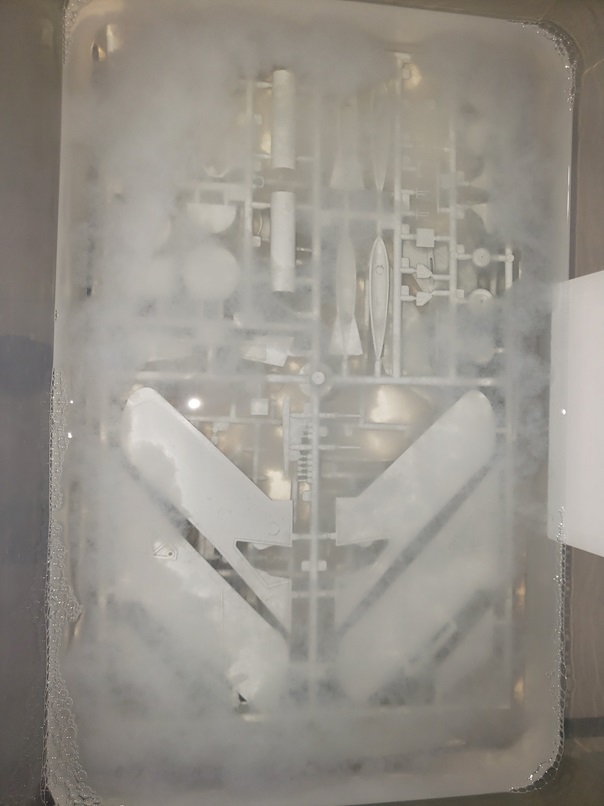
I soak the sprues, sometimes overnight, in a container filled with water and with a very small amount of Dawn dishwashing liquid then rinse the sprues in another container filled with fresh water. Usually the sprues look the same in the water after soaking, but occasionally, I've seen some thin misty wisps of grease that have been removed from the sprues. One time on an old SMER MiG-17 kit, I looked in the container after soaking overnight and it was filled with lumpy white-colored masses that came off of the sprues! After this experience, I always wash my sprues before building. I know it's extra work that most of the time is unnecessary, but I like to give myself the maximum opportunity to minimize my build and painting problems.
I had a few previous bad experiences with acrylic paint beading up & fisheye-ing and removing all the sprue mold release grease prevents this. You also need to watch for the fingerprints you leave on the bare plastic before painting (but that's a different issue).
One of our IPMS members gave a presentation about his tour of the Eduard factory and showed a photo he took of a mold machine operator spraying the inside of the mold with a can of release lubricant so the stuff really is on the mold and likely on the plastic sprue too.
I soak the sprues, sometimes overnight, in a container filled with water and with a very small amount of Dawn dishwashing liquid then rinse the sprues in another container filled with fresh water. Usually the sprues look the same in the water after soaking, but occasionally, I've seen some thin misty wisps of grease that have been removed from the sprues. One time on an old SMER MiG-17 kit, I looked in the container after soaking overnight and it was filled with lumpy white-colored masses that came off of the sprues! After this experience, I always wash my sprues before building. I know it's extra work that most of the time is unnecessary, but I like to give myself the maximum opportunity to minimize my build and painting problems.


![Pampers Sensitive Baby Wipes, Clinically Proven, Fragrance Free, Unscented, Water Based, Hypoallergenic, Multi-Use, Hand Wipes 336 Wipes Total (6X Flip-Top Packs) [Packaging May Vary]](https://m.media-amazon.com/images/I/41KLBHu9CAL._SL500_.jpg)





As an Amazon Associate we earn from qualifying purchases. Product prices and availability are accurate as of the date/time indicated and are subject to change.

kevin
Well-Known Member
I've never washed the sprues before and never had an issue until my last couple of kits. Both kits were from Trumpeter, 1/16 scale armour.I had a few previous bad experiences with acrylic paint beading up & fisheye-ing and removing all the sprue mold release grease prevents this.
I had the same effect on a couple of parts when using Mission Model acrylics.
I think I will wash my next kit from Trumpeter. Besides that, Trumpeter kits are good to in my opinion.

blakeh1
Well-Known Member
I generally do not wash the sprues, but I was recently working on the AMT/Round2 Razor Crest and it had a weird greasy feel to the plastic that I had never encountered before with other AMT kits. Not sure if it was maybe due to the metallic effect on the plastic or not.
so, mostly no, unless I specifically notice an issue with the plastic
so, mostly no, unless I specifically notice an issue with the plastic
blakeh1
Well-Known Member
I had a weird issue with Mission Model paints and will never use them againI've never washed the sprues before and never had an issue until my last couple of kits. Both kits were from Trumpeter, 1/16 scale armour.
I had the same effect on a couple of parts when using Mission Model acrylics.
I think I will wash my next kit from Trumpeter. Besides that, Trumpeter kits are good to in my opinion.
I used them over a primed model and while paint went on ok, when dried is was actually not waterproof. If I got a part wet, it acted like water was actually a solvent like painter remover or alcohol and would just start disintegrating
I later found that while the instructions say it is not needed, you really need to add some kind of special "varnish like" stuff to their paint so it "hardens" properly.
Never had an issue like that with Tamiya or Vallejo and just too fiddly for me
kevin
Well-Known Member
I've experienced the same issue with Mission Model paint as well. I'm not going to purchase anymore


BlackSheepTwoOneFour
Well-Known Member
- Joined
- Jun 9, 2013
- Messages
- 1,026
I had a weird issue with Mission Model paints and will never use them again
I used them over a primed model and while paint went on ok, when dried is was actually not waterproof. If I got a part wet, it acted like water was actually a solvent like painter remover or alcohol and would just start disintegrating
I later found that while the instructions say it is not needed, you really need to add some kind of special "varnish like" stuff to their paint so it "hardens" properly.
Never had an issue like that with Tamiya or Vallejo and just too fiddly for me
I love Mission Model paints but will only buy certain colors (tire black, worn tire black and others)
The one glaring downside of Mission Models paint it's easily scratched. A coat of enamel clearcoat will prevent that. It does help on primed surface and use their thinner for airbrushing.
BlackSheepTwoOneFour
Well-Known Member
- Joined
- Jun 9, 2013
- Messages
- 1,026
Ok, most of y'all don't wash your models?
That's just weird?
How do you chew on that filthy sprue right outta the box?
When I lick a rear stabilizer, that baby's gonna taste like Super Clean. Or DAWN.
You folks are gross.
Rob.
It's a matter of preference.
I rarely wash my sprues. What difference does it make if you're going to put a primer coat on. Washing sprues is a waste of time for me - except for resin kits.
BlackSheepTwoOneFour
Well-Known Member
- Joined
- Jun 9, 2013
- Messages
- 1,026
In all honesty, it's definitely a different animal. Yes, they scratch easily once dried - nothing but a coat of enamel clear can fix it. When I first used Mission Models paint, it is a learning experience. Once you figure out how to tame it, you shouldn't have issues. Airbrush straight out of the bottle or thin using their brand thinner for airbrushing. A primer coat helps too. But…. DO NOT a thin with water for airbrushing.I've experienced the same issue with Mission Model paint as well. I'm not going to purchase anymore
BlackSheepTwoOneFour
Well-Known Member
- Joined
- Jun 9, 2013
- Messages
- 1,026
Not important. A majority of hobbyist don't wash sprues. Like I've already mentioned, it's a matter of preference.How important is it to wash a new model in soap and water?
athabascamaverick
Well-Known Member
- Joined
- May 5, 2023
- Messages
- 147
I've been modeling since the mid-60's and never washed a model yet (outside of something I removed paint from) - never had any problems - use a good primer and you'll be fine/

Plastic Pilot
Well-Known Member
- Joined
- May 25, 2024
- Messages
- 75
I used to wash the kits with water and dish detergent, but now I use IPA just like the ohbejuan said above.I no longer wash before hand, but I do wipe down the assembled model with IPA prior to primer
I had some issues with the primer which has peeled in a couple of occasions and ruined the paint job and I had to start allover again at the point where I was panel lining the kit. I dose not cost very much to wipe the kit with IPA... It doesn't happen till it happens.

Edbert
Well-Known Member
- Joined
- May 16, 2024
- Messages
- 3,123
I will wipe down the surface with a heavy dose of isopropyl, just the grocery store stuff not the industrial or shop type which is stronger. Only reason is to remove fingerprints and such before the paint goes down to avoid issues.
IPA is not beer, right?
(https://www.britannica.com/topic/India-pale-ale)
IPA is not beer, right?
(https://www.britannica.com/topic/India-pale-ale)

It depends on the kit manufacturer, how oily your fingers are, and what you plan to use to paint it.I've never washed a new model, does it really make any difference??
Some kit manufacturers leave a lot of mold release on the kit surface, which definitely interferes with paint bond.
How oily your hands are tends to vary both with the individual and the time of day. My hands tend to be very dry, thanks to years of exposure to alkali dust, yet there are times when I can see my oily fingerprints on a bare plastic part. Of course, if you wear gloves while assembling a model, it won't matter. (Yes, there are people who do.) Skin oil can interfere with paint bond.
Finally, what type of paint will you use?
Organic solvent paints (e.g., enamels) contain solvents that readily dissolve skin oil and some release agents (thus incorporating them into the paint, possibly with bad effects.) This includes paints like Tamiya and Gunze, which use alcohol solvents.
Aqueous (water) solvent paint systems are much more vulnerable to surface contamination, though some are more resistant than others.
As I use aqueous paints, I always wash or clean the model parts before assembly, and give the finished model a wipe down with either ethyl or isopropyl alcohol as Edbert does. I do use the concentrated alcohols, however. 90% isopropyl is available in most drug stores or online. For ethyl alcohol, I use Everclear™ 90%. You can also use "denatured" ethyl alcohol. For my reasons, see my reply to Edbert.
I don't think washing the kit in beer would be a good idea, but I also wipe down the model with alcohol before painting for the same reason as you.I will wipe down the surface with a heavy dose of isopropyl, just the grocery store stuff not the industrial or shop type which is stronger. Only reason is to remove fingerprints and such before the paint goes down to avoid issues.
IPA is not beer, right?
(https://www.britannica.com/topic/India-pale-ale)
However, I use the concentrated stuff, especially isopropyl alcohol, sometimes abbreviated as "IPA."
 The reason? Common rubbing alcohol is usually isopropyl, 70% concentration. It is made by diluting 90% with tap water. While tap water may be safe to drink (YMMV) it often contains quite a lot of dissolved minerals, which can be deposited on the model surface. I've had this happen, as where I live the water is saturated with calcium ("hard" water). So when I wash the kit parts before assembly (to get rid of any mold release) I then rinse it with distilled water.
You can get 90% isopropyl alcohol online, and most drug stores carry it, but you may have to ask. A little goes a long way.

OldManModeler
Well-Known Member
I wash the sprues in dish soap, and rinse and air dry. Just a habit since I had paint adhesion issues decades ago. I haven't had paint sticking problems ever since. So now my terrible paint jobs stay on forever.
No washing here including on "old" kits from the 70s and 80s. OTOH: I've thrown away all my MM and other acrylics that would be used for large areas. A lacquer based primer/paint will burn through dang near anything and stick. My only use for acrylics is small hand painted areas of aircraft. I keep a full set of Tamiya acrylics and a few select Vallejo colors for flight suits, marker lights, etc.
MM paints will never again darken my door. Too many super secret additives, mixing, and offerings to the gods to make it "kind of work". I switched to MRP lacquer over Mr Fine Surfacer 1500 a few years ago. Shake, spray, done. I've never had a failure with their product.
MM paints will never again darken my door. Too many super secret additives, mixing, and offerings to the gods to make it "kind of work". I switched to MRP lacquer over Mr Fine Surfacer 1500 a few years ago. Shake, spray, done. I've never had a failure with their product.
I couldn't agree more about MM (Model Mucker) acrylics. As for the rest, I hope you have a good spray booth.No washing here including on "old" kits from the 70s and 80s. OTOH: I've thrown away all my MM and other acrylics that would be used for large areas. A lacquer based primer/paint will burn through dang near anything and stick. My only use for acrylics is small hand painted areas of aircraft. I keep a full set of Tamiya acrylics and a few select Vallejo colors for flight suits, marker lights, etc.
MM paints will never again darken my door. Too many super secret additives, mixing, and offerings to the gods to make it "kind of work". I switched to MRP lacquer over Mr Fine Surfacer 1500 a few years ago. Shake, spray, done. I've never had a failure with their product.
I do. I spent the money to get a Pace booth and have it vented outside. Also, using an airbrush vs rattle can, the quantities of paint/solvents going in the air vs on the model is quite small anyway.I couldn't agree more about MM (Model Mucker) acrylics. As for the rest, I hope you have a good spray booth.
Good! That makes me happy.I do. I spent the money to get a Pace booth and have it vented outside. Also, using an airbrush vs rattle can, the quantities of paint/solvents going in the air vs on the model is quite small anyway.
While acrylics are generally far safer than enamels or most lacquers, one must also consider the cumulative effects of all the junk and garbage we cannot help but inhale every day. Also, the chemicals in modeling supplies may be legally "safe," but the legal definition of "safe" is not. "Safe" is anything that has not been proven far beyond reasonable doubt to be toxic or carcinogenic. This is very hard to do, since all statistical proofs, properly done, will not result in a 100% result. If the testing resulted in 99% percent toxic, and 1% non-toxic, the material can be labeled and sold as "safe." I once wrote an article for FSM on this subject. Paul Boyer almost didn't accept it because it was so frightening. I also gave a presentation on this to a local IPMS chapter. People turned white. One of the member's wife was there with their newborn. She turned to her husband and said, "You will not touch another model until you have a spray booth."Carcinogens are like bullets. If one hits you, it's going to be bad. Some are only BBs. Some are 30mm HEAT rounds.
Sorry to be so cheerful, but the topic is one I'm passionate about.
Edbert
Well-Known Member
- Joined
- May 16, 2024
- Messages
- 3,123
I have zero medical training, I took High School Biology in about 1979/1980, so much of what we were taught could even have been superseded by now.Carcinogens are like bullets. If one hits you, it's going to be bad. Some are only BBs. Some are 30mm HEAT rounds.
But I adhere to a theory that many do, that cancer has more to do with genetics than environment, it is definitely something you can inherit, but even that is no guarantee. I've known people 90+ who smoked multiple packs of cigarettes a day who have no lung cancer while others get it in their 20s or 30s. Again, I'm making generalizations and assumptions with no formal education on the subject. But observation is a core component of the scientific theory. I just spent all of my science credits in college on Astronomy

Do not take this to mean that I eschew safety equipment, or in the case of toxic chemicals even basic common sense. Do not play with guns, run with scissors, play golf in a lightning storm, or tempt fate in any way. I wear a real respirator (change the cartridges regularly based on use) and have the garage door open if I am spraying lacquers or enamels, and if the acrylic session will be long I open the door, which sucks in Texas summers.


